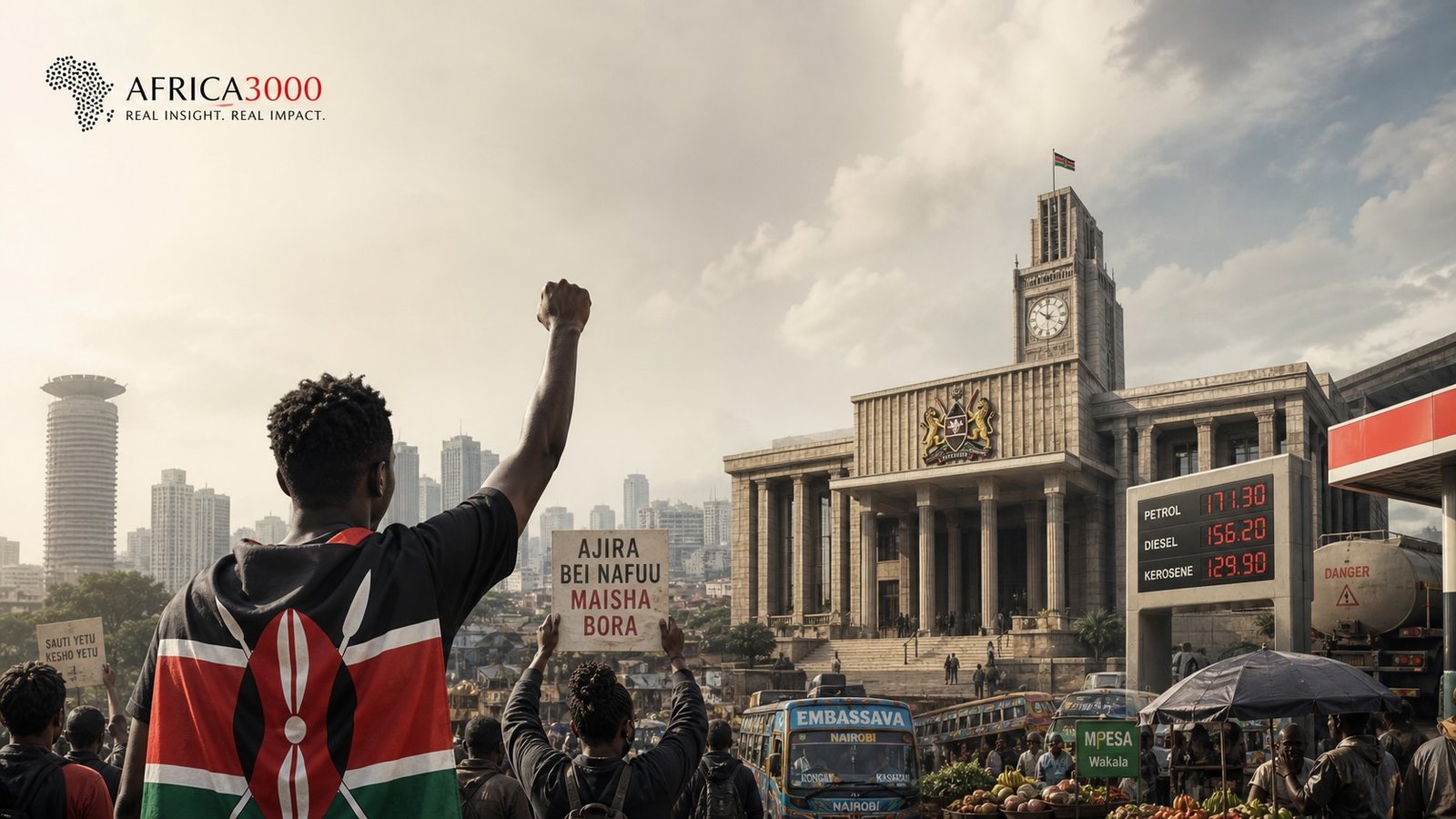
The Price of Stability
Politics, economy and civic power — explained for Europe.
Executive Snapshot
Fuel & Inflation: Kenya is absorbing part of the global energy shock, but the cost is moving from petrol stations to the public budget.
Election Risk: The approach to 2027 is making institutional trust—not merely coalition arithmetic—the central political question.
Youth & Work: Training and entrepreneurship schemes continue to expand, while the economy still struggles to create enough secure entry points for young people.
Fuel & Inflation
The fuel tax extension buys time, but it shifts the fiscal burden rather than removing it.
Election Risk
By 2027, trust in institutions may matter more than elite coalition arithmetic.
Youth & Work
Training is growing, but formal jobs are not keeping pace with the number of young Kenyans seeking entry.
Editorial Note
Kenya’s government has bought itself three months of economic breathing room. By extending the reduced VAT rate on petroleum products, it has prevented an immediate rise in pump prices at a moment when international energy disruption is feeding directly into inflation and household anxiety.
Yet this is not simply a story about fuel. It captures a broader governing dilemma: the state needs revenue, but every visible tax increase now carries political meaning. Fiscal policy is being interpreted through the memory of recent protests, allegations of police violence and a public belief that ordinary citizens are repeatedly asked to absorb the costs of government.
Kenya is not economically paralysed. Its currency is broadly stable, agriculture remains supportive, credit conditions have improved and the country retains substantial regional influence. But stability is becoming expensive to maintain—financially, politically and institutionally. The question is not whether Kenya can manage the next price shock. It is whether temporary relief can be converted into durable public confidence.
Featured Story
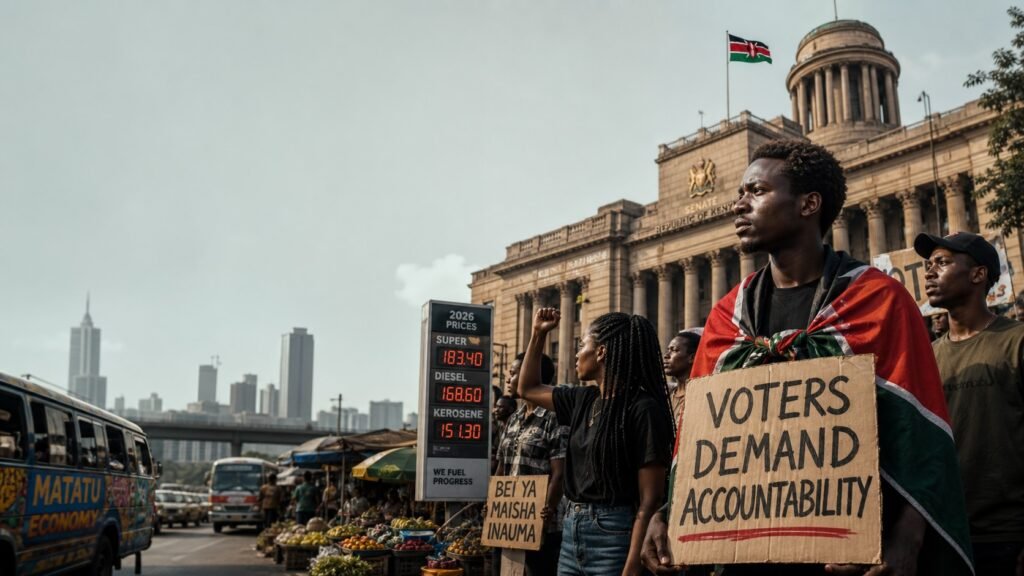
Fuel Relief Buys Time, Not a Solution
The Kenyan government has extended the reduced 8 percent VAT rate on petroleum products until 14 October 2026, rather than allowing it to return to 16 percent. Fuel prices for the next monthly cycle have also been held unchanged: in Nairobi, petrol remains at Sh214.03 per litre, diesel at Sh222.86, and kerosene at Sh191.38. The intervention is designed to shield households and businesses from renewed global energy-price pressure.
The relief is economically understandable. Transport costs influence food distribution, manufacturing, public transport and almost every urban service. Kenya’s June inflation rate was 6.41 percent, according to the Central Bank, already reflecting greater pressure on household purchasing power. The shilling has remained comparatively steady, trading at roughly 147.5 Kenyan shillings per euro, but currency stability cannot fully offset a sustained rise in imported oil costs.
The political significance is greater than the immediate tax calculation. Fuel taxation has become one of the most visible symbols of the relationship between citizens and the state. A litre of petrol contains not only an economic cost but also a judgement about who is expected to finance public policy.
The government is therefore choosing short-term price restraint over immediate revenue collection. That may reduce pressure on commuters and businesses, but it also narrows fiscal room elsewhere. Previous VAT relief had already cost the Treasury an estimated Sh24 billion, according to statements reported by Business Daily. If global energy prices remain elevated, the government will eventually face a difficult choice: extend subsidies, accept higher inflation or recover revenue through other taxes and spending cuts.
What the headlines mean
Our Take
The fuel-tax extension is the correct immediate decision, but it should not be mistaken for a long-term economic strategy.
Kenya’s government is confronting a genuine external shock. Allowing fuel prices to rise sharply would feed inflation, transport costs and public anger. Yet repeated temporary relief also exposes the fragility of a fiscal system heavily dependent on consumption taxes and costly borrowing.
Our editorial assessment is that the government’s greatest risk is not a single unpopular tax. It is the widening perception that policy is reactive: prices rise, protests follow, concessions are announced, and the underlying structure remains unchanged.
Kenya needs a clearer public account of how tax revenue is used, which expenditures can be reduced and how debt relief will translate into better services or economic opportunity. Citizens may tolerate difficult policy. They are less likely to accept sacrifice when the burden appears unequal or the benefits invisible.
Why Europe Should Care
Kenya is a major diplomatic, commercial and humanitarian hub for East Africa. Its stability influences regional trade, investment, security cooperation, refugee policy and the work of international organisations headquartered in Nairobi.
For European governments and foundations, the lesson is that macroeconomic stability cannot be separated from political trust. Support for debt reform, vocational education or private investment will have limited legitimacy if citizens believe institutions are unaccountable.
European businesses should also watch fuel costs, inflation and political mobilisation closely. Kenya remains one of Africa’s most capable and connected markets, but consumer demand and investor confidence are increasingly influenced by the state’s ability to manage social pressure without closing civic space.