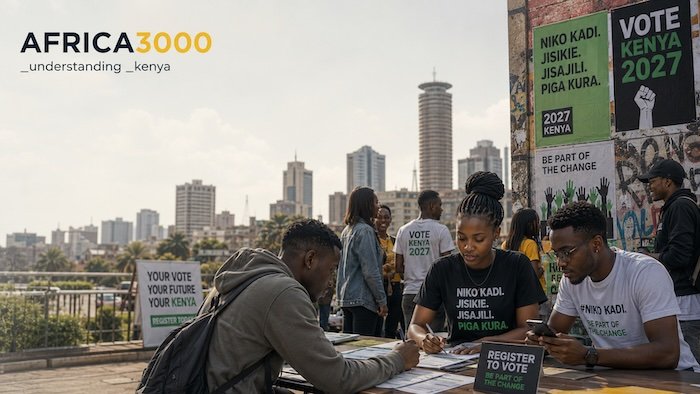
Kenya’s Gen Z Is Moving Toward the Ballot
The youth vote is becoming one of the clearest storylines of the 2027 election cycle, with online energy increasingly turning into voter registration and local political pressure.
Executive Snapshot
Gen Z and the ballot: Kenya’s young voters are no longer only a digital force; they are increasingly shaping registration drives and local campaign strategy.
Ol Kalou’s signal: The by-election debate has shown how quickly youth turnout, or its absence, becomes part of the national conversation.
2027 implications: Parties are responding by speaking more directly to young voters, especially those drawn into civic action in 2024 and 2025.
Digital influence
Gen Z still shapes the conversation online, but the test now is turnout and registration.
Local pressure
By-elections are revealing whether youth energy reaches polling stations.
National shift
Campaigns are already adapting their tone to younger voters.
Editorial Note
Kenya’s Gen Z has become one of the most closely watched political groups in the country. The generation that helped drive the protests of 2024 is now being courted in a different way: through voter registration drives, digital campaigns and direct appeals to first-time voters. That shift matters because it shows a movement that is not simply expressing frustration, but looking for a route into formal politics.
The key question is not whether young people matter. They clearly do. The real issue is how their influence will show up in 2027 — through turnout, through candidate choices, and through the pressure they place on older political formations to change how they speak and govern. In that sense, Gen Z is already changing the election, even before the campaign properly begins.
Featured Story
From Street Energy to Voter Cards
Recent reporting shows a clear evolution in Kenya’s youth politics. The same generation that made itself visible through street protests is now being organised around voter registration, civic education and peer-to-peer mobilisation. Campaigns such as Niko Kadi have helped turn a digital identity into something more practical: the act of getting on the register.
This is where Gen Z’s influence becomes more interesting. Social media can shape the mood of the country, but elections are decided by people who are registered and who turn up. That is why voter registration has become such a focal point. It is not just a technical exercise; it is the bridge between online visibility and real political leverage.
The Ol Kalou by-election added another layer to the story. The public debate around the contest showed that observers are now reading local results as clues about youth engagement and political momentum. In other words, Gen Z is no longer being discussed only as a protest generation, but as a generation that may help decide which coalitions matter in 2027.